61 questions0 / 61 done
Questions per paper
- All
- MCQ
- MSQ
- NAT
2015 to 2026. Point at a year to read it.
Show as a table
| Year | All | MCQ | MSQ | NAT |
|---|---|---|---|---|
| 2015 | 0 | 0 | 0 | 0 |
| 2016 | 5 | 3 | 0 | 2 |
| 2017 | 3 | 2.5 | 0 | 0.5 |
| 2018 | 5 | 3 | 0 | 2 |
| 2019 | 6 | 6 | 0 | 0 |
| 2020 | 6 | 6 | 0 | 0 |
| 2021 | 5 | 1 | 0 | 4 |
| 2022 | 6 | 6 | 0 | 0 |
| 2023 | 6 | 5 | 0 | 1 |
| 2024 | 6 | 3 | 0 | 3 |
| 2025 | 6 | 3 | 1 | 2 |
| 2026 | 4 | 4 | 0 | 0 |
- 1EE 2026 · 1 mark · MCQ · ModerateThe Laplace transform of the step response of a system is given by
- 2EE 2026 · 1 mark · MCQ · EasyThe asymptotic Bode magnitude plot of a system is shown.
- 3EE 2026 · 2 marks · MCQ · ModerateA system is characterized by the following state equation and output equation (: input, : state vector, : output)
- 4EE 2026 · 2 marks · MCQ · ModerateA system is represented in state-space form as follows: (: input, : state vector, : output)
- 5EE 2025 · 1 mark · MCQ · ModerateSelected data points of the step response of a stable first-order linear time-invariant (LTI) system are given below. The closest value of the time-constant, in , of the system is
- 6EE 2025 · 1 mark · MCQ · HardThe Nyquist plot of a strictly stable having the numerator polynomial as encircles the critical point once in the anti-clockwise direction. Which one of the following statements on the closed-loop system shown in figure, is correct?
- 7EE 2025 · 1 mark · MSQ · ModerateThe open-loop transfer function of the system shown in the figure, is
- 8EE 2025 · 2 marks · MCQ · ModerateLet . Then the closed-loop system shown in the figure below, is
- 9EE 2025 · 2 marks · NAT · ModerateConsider the state-space model where are the state, input and output, respectively. The matrices are given below The sum of the magnitudes of the poles is _____ (\textit{round off to nearest integer}).
- 10EE 2025 · 2 marks · NAT · ModerateA controller of the form is to be designed for the plant as shown in the figure. The value of that yields a phase margin of at the gain cross-over frequency of is ____ (round off to one decimal place).
- 11EE 2024 · 1 mark · MCQ · ModerateFor the block-diagram shown in the figure, the transfer function is
- 12EE 2024 · 1 mark · MCQ · ModerateConsider the standard second-order system of the form with the poles and having negative real parts. The pole locations are also shown in the figure. Now consider two such second-order systems as defined below:
- 13EE 2024 · 1 mark · MCQ · ModerateConsider the cascaded system as shown in the figure. Neglecting the faster component of the transient response, which one of the following options is a first-order pole-only approximation such that the steady-state values of the unit step responses of the original and the approximated systems are same?
- 14EE 2024 · 2 marks · NAT · ModerateConsider the closed-loop system shown in the figure with The root locus for the closed-loop system is to be drawn for . The angle of departure (between and ) of the root locus branch drawn from the pole , in degrees, is ____ (rounded off to the nearest integer).
- 15EE 2024 · 2 marks · NAT · ModerateConsider the stable closed-loop system shown in the figure. The asymptotic Bode magnitude plot of has a constant slope of at least till with the gain crossover frequency being . The asymptotic Bode phase plot remains constant at at least till . The steady-state error of the closed-loop system for a unit ramp input is ____ (rounded off to 2 decimal places).
- 16EE 2024 · 2 marks · NAT · ModerateConsider the stable closed-loop system shown in the figure. The magnitude and phase values of the frequency response of are given in the table. The value of the gain () for a phase margin is ____ (rounded off to 2 decimal places).
- 17EE 2023 · 1 mark · MCQ · ModerateFor the block diagram shown in the figure, the transfer function is
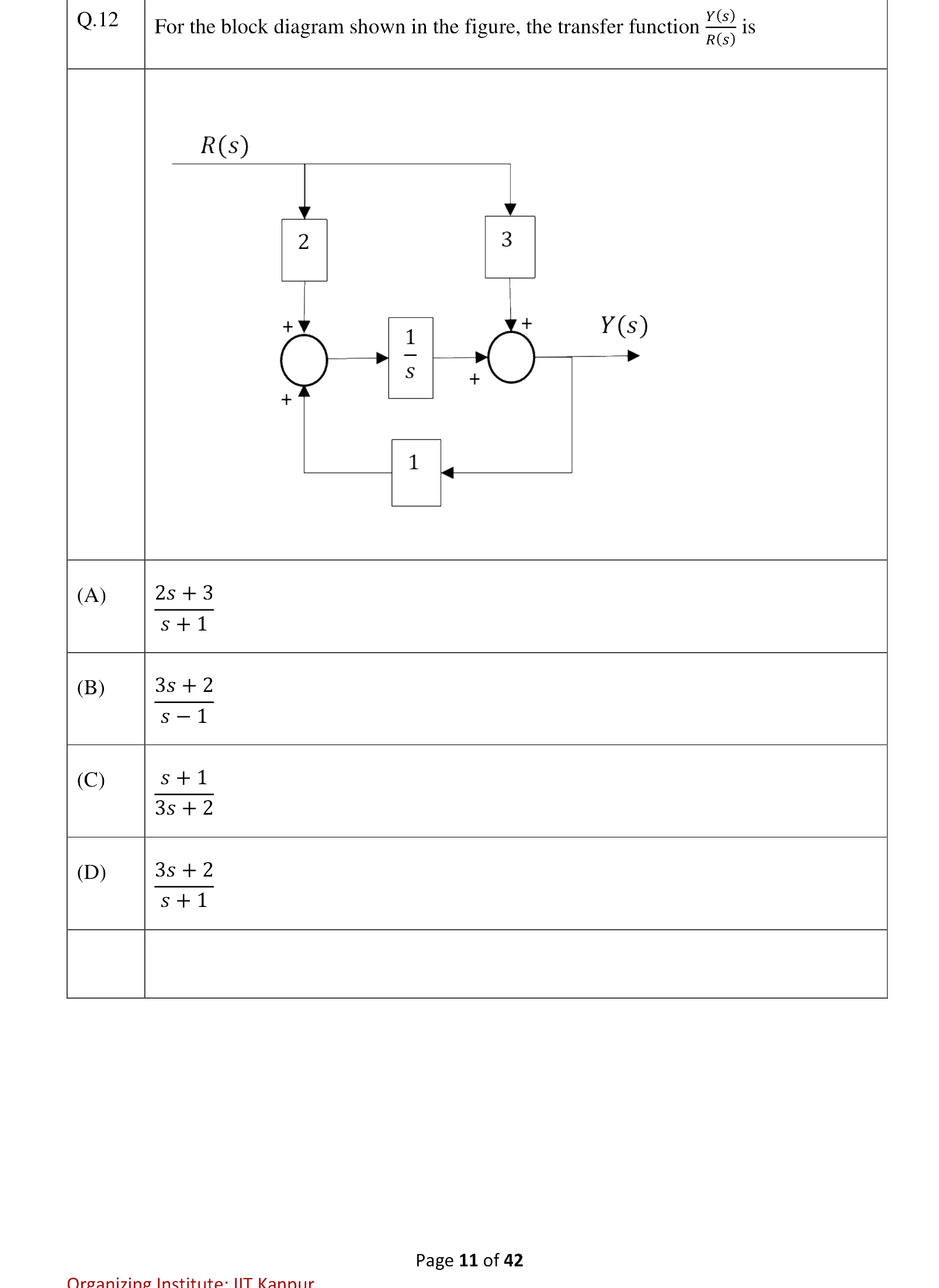
- 18EE 2023 · 1 mark · MCQ · EasyIn the Nyquist plot of the open-loop transfer function
- 19EE 2023 · 1 mark · MCQ · ModerateConsider a unity-gain negative feedback system consisting of the plant (given below) and a proportional-integral controller. Let the proportional gain and integral gain be and , respectively. For a unit step reference input, the final values of the controller output and the plant output, respectively, are
- 20EE 2023 · 2 marks · MCQ · ModerateThe magnitude and phase plots of an LTI system are shown in the figure. The transfer function of the system is
- 21EE 2023 · 2 marks · MCQ · ModerateConsider a lead compensator of the form The frequency at which this compensator produces maximum phase lead is . At this frequency, the gain amplification provided by the controller, assuming asymptotic Bode-magnitude plot of , is . The values of , respectively, are
- 22EE 2023 · 2 marks · NAT · ModerateConsider the state-space description of an LTI system with matrices For the input, , , the value of for which the steady-state output of the system will be zero, is ________ (Round off to the nearest integer).
- 23EE 2022 · 1 mark · MCQ · ModerateThe transfer function of a real system, , is given as:
- 24EE 2022 · 1 mark · MCQ · HardThe Bode magnitude plot of a first order stable system is constant with frequency. The asymptotic value of the high frequency phase, for the system, is . This system has
- 25EE 2022 · 1 mark · MCQ · EasyThe open loop transfer function of a unity gain negative feedback system is given by
- 26EE 2022 · 2 marks · MCQ · ModerateAn LTI system is shown in the figure where
- 27EE 2022 · 2 marks · MCQ · ModerateThe open loop transfer function of a unity gain negative feedback system is given as
- 28EE 2022 · 2 marks · MCQ · ModerateThe damping ratio and undamped natural frequency of a closed loop system as shown in the figure, are denoted as and , respectively. The values of and are
- 29EE 2021 · 1 mark · MCQ · EasyFor the closed-loop system shown, the transfer function is
- 30EE 2021 · 1 mark · NAT · ModerateThe Bode magnitude plot for the transfer function of the circuit is as shown. The value of is ____ . (Round off to 2 decimal places.)
- 31EE 2021 · 2 marks · NAT · ModerateConsider a closed-loop system as shown. is the plant transfer function and is the compensator. For a unit-step input, the output response has damped oscillations. The damped natural frequency is ____________ . (Round off to 2 decimal places.)
- 32EE 2021 · 2 marks · NAT · ModerateIn the given figure, plant and compensator . The external disturbance input is . It is desired that when the disturbance is a unit step, the steady-state error should not exceed unit. The minimum value of is ______. (Round off to 2 decimal places.)
- 33EE 2021 · 2 marks · NAT · EasyThe state space representation of a first-order system is given as where, is the state variable, is the control input and is the controlled output. Let be the control law, where is the controller gain. To place a closed-loop pole at , the value of is ______.
- 34EE 2020 · 1 mark · MCQ · EasyConsider a linear time-invariant system whose input and output are related by the following differential equation:
- 35EE 2020 · 1 mark · MCQ · EasyWhich of the options is an equivalent representation of the signal flow graph shown here?
- 36EE 2020 · 2 marks · MCQ · ModerateConsider a permanent magnet dc (PMDC) motor which is initially at rest. At , a dc voltage of is applied to the motor. Its speed monotonically increases from to in and finally settles to . Assuming that the armature inductance of the motor is negligible, the transfer function for the motor is
- 37EE 2020 · 2 marks · MCQ · ModerateWhich of the following options is correct for the system shown below?
- 38EE 2020 · 2 marks · MCQ · EasyConsider a negative unity feedback system with the forward path transfer function
- 39EE 2020 · 2 marks · MCQ · ModerateA stable real linear time-invariant system with single pole at , has a transfer function with a dc gain of . The smallest positive frequency, in , at unity gain is closest to:
- 40EE 2019 · 1 mark · MCQ · EasyThe output response of a system is denoted as , and its Laplace transform is given by
- 41EE 2019 · 1 mark · MCQ · ModerateThe open loop transfer function of a unity feedback system is given by In plane, the Nyquist plot of passes through the negative real axis at the point
- 42EE 2019 · 1 mark · MCQ · ModerateThe characteristic equation of a linear time-invariant (LTI) system is given by
- 43EE 2019 · 2 marks · MCQ · ModerateThe asymptotic Bode magnitude plot of a minimum phase transfer function is shown below.
- 44EE 2019 · 2 marks · MCQ · EasyThe transfer function of a phase lead compensator is given by The frequency (in ), at which is maximum, is
- 45EE 2019 · 2 marks · MCQ · ModerateConsider a state-variable model of a system
- 46EE 2018 · 1 mark · MCQ · EasyMatch the transfer functions of the second-order systems with the nature of the systems given below.
- 47EE 2018 · 1 mark · NAT · EasyConsider a unity feedback system with forward transfer function given by
- 48EE 2018 · 2 marks · MCQ · ModerateConsider a system governed by the following equations
- 49EE 2018 · 2 marks · MCQ · HardThe number of roots of the polynomial, , in the open left half of the complex plane is
- 50EE 2018 · 2 marks · NAT · EasyThe unit step response of a unity feedback system with open loop transfer function is shown in the figure. The value of is ____ (up to 2 decimal places).
- 51EE 2017 Set 2 · 1 mark · MCQ · ModerateWhen a unit ramp input is applied to the unity feedback system having closed loop transfer function the steady state error will be
- 52EE 2017 Set 2 · 1 mark · MCQ · ModerateThe transfer function of a compensator is given below.
- 53EE 2017 Set 2 · 2 marks · MCQ · ModerateThe root locus of the feedback control system having the characteristic equation where enters into the real axis at
- 54EE 2017 Set 2 · 2 marks · MCQ · EasyThe range of for which all the roots of the equation are in the left half of the complex s-plane is
- 55EE 2017 Set 2 · 2 marks · MCQ · EasyWhich of the following systems has maximum peak overshoot due to a unit step input?
- 56EE 2017 Set 2 · 2 marks · NAT · ModerateConsider the system described by the following state space representation
- 57EE 2016 Set 2 · 1 mark · NAT · EasyConsider a linear time-invariant system with transfer function
- 58EE 2016 Set 2 · 1 mark · NAT · ModerateFor the network shown in the figure below, the frequency (in ) at which the maximum phase lag occurs is, ____.
- 59EE 2016 Set 2 · 2 marks · MCQ · ModerateThe open loop transfer function of a unity feedback control system is given by
- 60EE 2016 Set 2 · 2 marks · MCQ · EasyA second-order real system has the following properties: a) the damping ratio and undamped natural frequency , b) the steady state value of the output, to a unit step input, is . The transfer function of the system is
- 61EE 2016 Set 2 · 2 marks · MCQ · ModerateThe gain at the breakaway point of the root locus of a unity feedback system with open loop transfer function is